
What costs money
The first completed eligible validation is free per GitHub App installation. Later completed runs use prepaid credits or an applicable grant. A valid inconclusive or no-signal result may still be chargeable. Calls made through your own model-provider key are billed by that provider. A run that fails before a valid measurement result follows the documented non-charge and error rules.See the rate and the charge
Validate posts an estimate before measurement. After a completed run, the result records the actual cost. Open Studio → Account → Billing to see your current credit balance, usage rates and transactions. Open Billing in Studio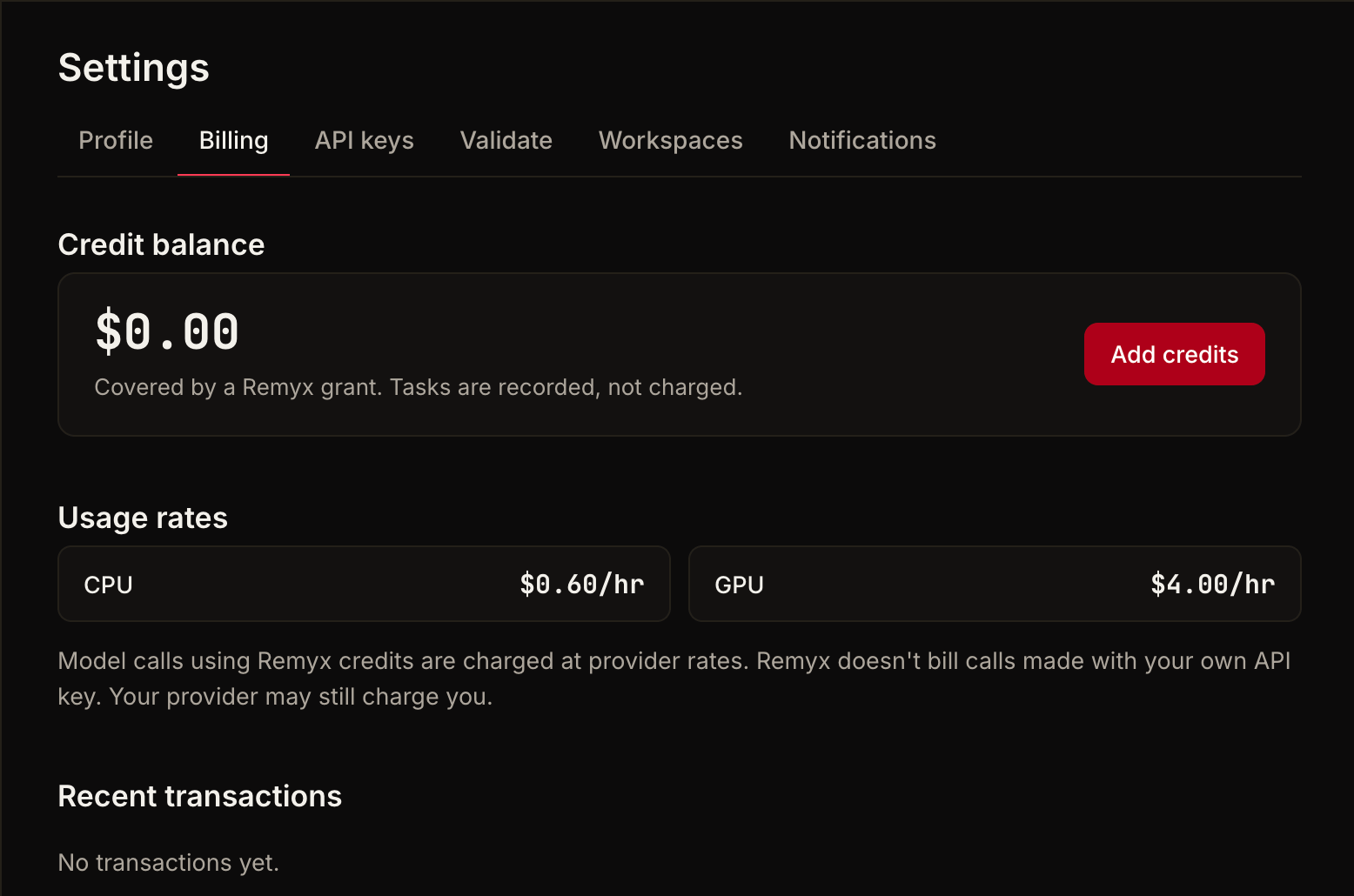
Studio Billing shows the available credits, current compute rates, and transaction section.
Details
The tables below define eligibility, rates, usage accounting, grants, failed runs and other charge conditions.
Nav: Account → Billing | URL:
/account?tab=billing
What admits a validation
When you mention the bot, the account that owns the repo’s App installation is checked, in this order. The first that applies admits the run.
Nothing else admits. A refusal is one line on the PR that names what fixes it, and it always ends with “Nothing was used”. The gate fails closed: a lookup error is a refusal, never a free run.
When you are charged
Once, when the measurement run finalizes with a verdict or a valid abstention (No signal, Inconclusive). Never:- on the smoke run that precedes the measurement;
- on an error or an infrastructure failure, which also does not consume the free validation;
- mid-run. Everything that could refuse a run is checked before it starts: entitlement, the funded allowance, a run already in flight on the repo, a dead model key.
What it costs
Check the current rates in Studio before running. CPU, GPU, model calls funded by Remyx, and validation fees may contribute to a charge. Calls made with your own model key are billed by your provider. The example numbers in this guide are not a quote for your run.
The current rates are on Account → Billing → Usage rates and in the
prices block of GET /billing, which any key with billing:read can call. Production sets its own rates (CPU $0.60/h and GPU $4.00/h as of November 3, 2026, multiplier 1.0, fee $0). The code defaults are lower and are not what you are charged. Do not budget from the defaults or from this page. Read the rates page.
The started comment on the PR quotes a ceiling (“up to ~$0.90 on CPU, includes first-time environment build”): the per-job cost at the run’s own deadline, times arms and seeds, plus a build allowance for each arm with no cached image. The verdict footer shows the actual.
Free first run
Each App installation gets one free validation. It is used when a validation completes with a verdict or a valid abstention (No signal, Inconclusive), so a run that dies on infrastructure leaves it intact. With no model provider connected, the free run’s test is designed and repaired on a Remyx-funded model, within caps that are code defaults production may change: $2 per job, $5 per account, $50 per day across all accounts. When a cap is reached the bot says so and names the two ways on: add credits, or connect your own provider. On a paid run, funded model calls are priced into the debit instead.Add credits
1
Open Account → Billing
The Credit balance section shows the balance and Add credits. On a deployment with no Stripe key it says “Top-ups aren’t enabled on this deployment”.
2
Pick an amount
Presets of $20, $50 and $100, or any amount from $10 to $2,000.
3
Pay in Stripe Checkout
Promotion codes are accepted. You return to the account page with
?credits=paid or ?credits=cancelled.4
The balance updates once Stripe confirms
Usually within a minute. The credit is keyed on the Stripe event id, so a redelivered event never credits twice.
studio.remyx.ai/account?buy=credits, which opens the same flow signed in. The verdict footer shows Add credits when the balance is below the larger of the last debit and $5.
Statement
Account → Billing → Recent transactions lists every credit and debit. The balance is derived from that ledger, not stored, so it cannot drift from the statement. Each debit names the repo and PR it paid for and the cost breakdown (compute, model calls, fee). An account covered by a grant sees “Covered by a Remyx grant. Tasks are recorded, not charged.”What you see on the PR
Grants and teams
Grants are written by the Remyx team, not self-served: design partners, sponsored open-source maintainers, pilots. Contact us with the repo or GitHub organization. A grant can be counted (N validations), unlimited, or expiring, and it can sit on the account or on the installation’s GitHub login so every repo under that organization is covered. A trusted grant also unlocks the Docker-in-Docker sidecar for runs that need to build or run containers inside the measurement. Trust is a property of the account, so it applies to that account’s free run too. The free validation and the balance are untrusted by default.API
The
billing scope category (read and write) is new; keys created before it need the scope added under Account → API keys. The Stripe webhook and the grants routes are internal.
Related
Validate
What a validation is and how to run one
Account
The Billing tab
API scopes
billing:read and billing:writeModel providers
Outrider bills your provider, not Remyx